
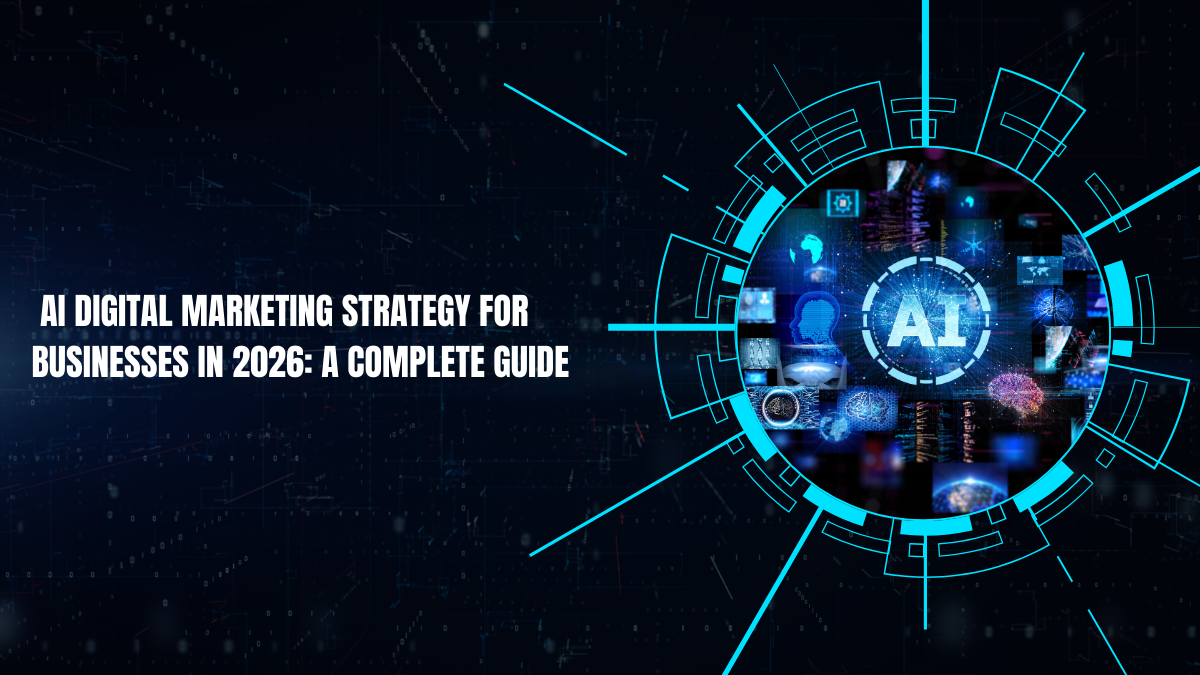
AI Digital Marketing Strategy for Businesses in 2026: A Complete Guide
Artificial Intelligence (AI) is rapidly transforming the way businesses approach digital marketing. From automated content creation to predictive analytics and intelligent customer targeting, AI is enabling organizations to market more efficiently and effectively than ever before.
By 2026, businesses that integrate AI into their digital marketing strategies will have a significant competitive advantage. AI-powered marketing allows companies to analyze large volumes of customer data, personalize marketing campaigns, and automate repetitive tasks that previously required manual effort.
This article explores the AI digital marketing strategy businesses should adopt in 2026, including key technologies, tools, and frameworks that help companies generate leads, improve customer engagement, and increase return on investment.
What is AI Digital Marketing?
AI digital marketing refers to the use of artificial intelligence technologies such as machine learning, natural language processing, and predictive analytics to enhance marketing activities.
Instead of relying solely on manual marketing processes, AI-powered systems analyze data, identify patterns, and automatically optimize campaigns.
Businesses use AI in digital marketing for several purposes, including:
- Customer behavior analysis
- Marketing automation
- Personalized customer experiences
- Predictive lead generation
- AI-powered content creation
- Campaign performance optimization
The goal of AI marketing is to deliver the right message to the right customer at the right time using intelligent automation.
Why AI is Transforming Digital Marketing in 2026
Digital marketing has become more data-driven and competitive. Customers interact with brands across multiple channels such as search engines, social media, websites, mobile apps, and email.
Managing these touchpoints manually is complex and inefficient. AI helps businesses process massive amounts of data and convert insights into actionable marketing strategies.
Several factors are driving the adoption of AI in digital marketing:
1. Increasing Data Volume
Businesses collect vast amounts of customer data through websites, apps, social media platforms, and CRM systems. AI can analyze this data in real time to uncover valuable insights.
2. Personalization Expectations
Modern consumers expect personalized experiences. AI enables businesses to deliver personalized recommendations, targeted ads, and tailored marketing messages.
3. Marketing Automation
AI-powered automation tools reduce manual workload by automating tasks such as email marketing, lead nurturing, and campaign optimization.
4. Improved Marketing ROI
AI can continuously monitor campaign performance and automatically adjust strategies to improve results and reduce advertising costs.
For businesses aiming to scale their marketing efforts, AI is no longer optional—it is essential.
Key Components of an AI Digital Marketing Strategy
A successful AI digital marketing strategy involves integrating AI technologies across multiple marketing functions.
Below are the most important components businesses should consider when implementing AI marketing strategies.
1. AI-Powered Content Marketing
Content remains a critical part of digital marketing, and AI tools are revolutionizing how content is created and optimized.
AI-powered content tools help marketers generate blog posts, social media captions, email campaigns, product descriptions, and video scripts more efficiently.
AI can also analyze search trends and recommend topics that are more likely to rank in search engines.
Benefits of AI-powered content marketing include:
- Faster content creation
- SEO optimization insights
- Topic research and trend analysis
- Automated content personalization
However, businesses should combine AI-generated content with human editing to ensure quality, originality, and brand voice.
2. AI for Search Engine Optimization (SEO)
Search engine optimization is becoming increasingly data-driven, and AI plays a major role in modern SEO strategies.
AI tools can analyze search engine algorithms, identify ranking opportunities, and optimize website content for better visibility.
AI-based SEO strategies include:
- Keyword research and analysis
- Content optimization
- Competitor analysis
- Search intent identification
- Predictive ranking analysis
Businesses using AI-powered SEO tools can identify high-value keywords and improve their chances of ranking on search engine results pages.
3. AI-Powered Paid Advertising
Paid advertising platforms such as Google Ads and social media advertising tools already rely heavily on artificial intelligence.
AI can optimize ad campaigns by automatically adjusting bidding strategies, targeting audiences, and analyzing campaign performance.
Key advantages of AI-driven advertising include:
- Improved audience targeting
- Real-time campaign optimization
- Higher ad conversion rates
- Reduced advertising costs
AI can also generate ad creatives and test multiple variations to determine which ads perform best.
4. AI Chatbots and Conversational Marketing
AI-powered chatbots are becoming an essential tool for businesses that want to provide instant customer support and capture leads automatically.
Chatbots can interact with website visitors, answer questions, recommend products, and collect customer information.
Benefits of AI chatbots include:
- 24/7 customer support
- Instant responses to customer inquiries
- Automated lead qualification
- Improved customer engagement
Conversational marketing powered by AI helps businesses interact with potential customers in real time and guide them through the sales funnel.
5. Predictive Analytics and Customer Insights
One of the most powerful applications of AI in digital marketing is predictive analytics.
Predictive analytics uses machine learning algorithms to forecast future customer behavior based on historical data.
Businesses can use predictive insights to:
- Identify potential customers likely to convert
- Forecast product demand
- Reduce customer churn
- Optimize marketing budgets
By understanding customer behavior in advance, businesses can make smarter marketing decisions.
6. AI Marketing Automation
Marketing automation is a key element of AI digital marketing strategies.
Automation platforms allow businesses to create workflows that trigger marketing actions based on user behavior.
Examples of marketing automation include:
- Automated email campaigns
- Lead nurturing sequences
- Social media scheduling
- CRM data updates
- Customer segmentation
AI enhances automation by making workflows more intelligent and adaptive.
AI Digital Marketing Funnel
Businesses can integrate AI across every stage of the marketing funnel.
Awareness Stage
At the awareness stage, businesses attract potential customers through SEO, social media content, and paid advertising. AI tools help identify trending topics and optimize marketing campaigns to reach a larger audience.
Consideration Stage
During the consideration stage, potential customers evaluate different products or services. AI-powered marketing systems deliver personalized content, product recommendations, and targeted email campaigns.
Conversion Stage
AI can optimize landing pages and analyze user behavior to increase conversion rates. Smart algorithms determine which marketing messages encourage users to take action.
Retention Stage
AI also plays a role in customer retention. Businesses can use AI tools to analyze customer satisfaction and automatically trigger retention campaigns. Customer retention strategies may include loyalty programs, personalized offers, and automated follow-ups.
Popular AI Digital Marketing Tools
Many powerful AI tools help businesses implement AI marketing strategies effectively.
Common categories include:
Content Creation Tools
AI writing tools assist marketers with blog creation, ad copywriting, and social media content.
SEO and Analytics Tools
AI-powered SEO tools analyze keywords, search trends, and website performance.
Marketing Automation Platforms
Automation tools manage email marketing campaigns, CRM integration, and workflow automation.
AI Design Tools
Design tools generate visuals, marketing graphics, and creative assets for digital campaigns.
Using the right combination of AI tools helps businesses build an integrated digital marketing ecosystem.
Challenges of AI in Digital Marketing
While AI offers significant benefits, businesses should also consider certain challenges.
Data Privacy and Security
Companies must ensure that customer data is handled responsibly and complies with privacy regulations.
Over-Reliance on Automation
AI should support marketing teams, not replace strategic thinking and creativity.
Implementation Complexity
Adopting AI marketing systems may require technical expertise and proper integration with existing platforms.
Despite these challenges, the long-term benefits of AI marketing outweigh the initial learning curve.
The Future of AI Digital Marketing
AI will continue to evolve and reshape the digital marketing landscape.
Several emerging trends will define the future of AI marketing:
- Hyper-Personalization: AI will deliver highly personalized marketing experiences tailored to individual customers.
- Voice Search Marketing: Voice assistants and conversational interfaces will become important marketing channels.
- Generative AI Content: AI-generated videos, graphics, and marketing assets will become more common.
- Autonomous Marketing Systems: Fully automated marketing systems will manage campaigns with minimal human involvement.
Businesses that adapt to these trends early will gain a significant competitive advantage.
AI digital marketing strategies are transforming how businesses attract customers, generate leads, and optimize marketing campaigns.
By integrating artificial intelligence into content marketing, SEO, advertising, automation, and analytics, companies can build smarter marketing systems that deliver better results.
In 2026 and beyond, businesses that leverage AI technologies will outperform competitors relying on traditional marketing methods.
Organizations should begin adopting AI marketing frameworks today to stay competitive in an increasingly digital and data-driven marketplace.